|

|
 |
|
|
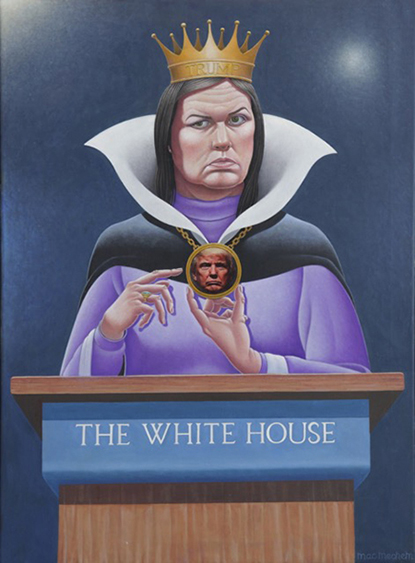
Mac Mechem, "Who's the Fairest of US All?" 2017, mixed media/oil on canvas,
36 x 26"
|
|
 |
|
|
|
“Trump Card”
Transmission Gallery,
Oakland, California
by DeWitt Cheng
|
|
|
Continuing through July 21, 2018
|
|
|
America's present sinister, clownish reign is the culmination of decades of activity by what Hillary Clinton once called "the vast right-wing conspiracy" (for which she was mocked by those conspirators). I am reminded of Hamlet scolding his mother for succumbing to his lecherous, murderous uncle, cruelly contrasting portraits of the noble and ignoble brothers:
This was your husband. Look you now, what follows.
Here is your husband, like a mildewed ear
Blasting his wholesome brother. Have you eyes?
Most of us do, even if the blind remain blusterous. And so now is assembled "Trump Card," an exemplary demonstration of First Amendment freedom… READ MORE |
|
|
Editors' Roundtable
by Richard Speer
Periodically I teach a workshop called "How to Write an Effective Artist Statement." One of the things I admonish the attendees is to never shy away from adding a sentence to their statements describing what thoughts or emotions they hope to elicit from the viewer. This advice invariably encounters resistance, and I think there are a few reasons why. For starters, the artists I teach fall into two camps: those who haven't attended art school and those who have. Those who haven't often don't have the words yet to describe what they hope the viewer will take away. Those who have can marshall plenty of words, but want them to be all about themselves: their private preoccupations with form, space, line, memory, gender — the standard MFA talking points. The viewer's experience is secondary or irrelevant. When I interview artists for profiles or catalogue essays and ask how they envision the viewer's experience, often I'm met with a long pause, followed either by "You know, I've never thought about that," or a haughty "That's not my concern." It's as if even considering the viewer would amount to pandering worthy of P.T. Barnum.
I understand and appreciate that to create, artists must honor their individual visions and the paths down which those visions take them. But I also believe that artists benefit when viewers — including gallerists, curators, and collectors — have an "in" to the artist's concerns and some guidance about how to respond. This benefits artists in ways both philosophical and pragmatic. It is not a lack of integrity, but an act of magnanimity to help others understand what we are trying to accomplish and why. It runs contrary to the elitism of expecting lay viewers to enter exhibitions cold and automatically infer, by virtue of sheer intellect and insight, what exactly is implied by a giant Paul McCarthy butt plug or a Marina Abramović stare-down. Furthermore and less altruistically, to "lead the witness" by tipping one's hand, even slightly, almost always serves the artist's self-interest. To self-disclose and invite identification is to set the stage with a Jedi mind trick of sorts: "These aren't the droids you're looking for, but here's what you'll find in my work, and here's what you might feel."
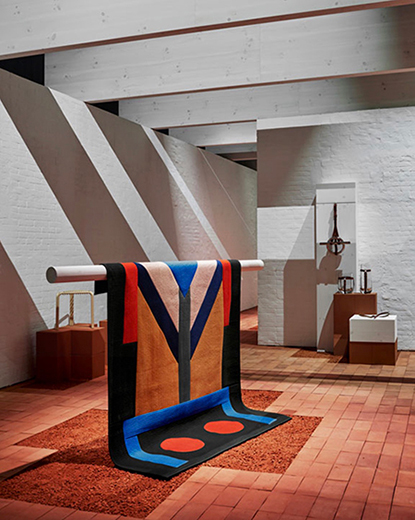
Inevitably at this point in my workshops, someone pipes up: "But I want viewers to form their own interpretations! I don't want to dictate their responses and ruin their thrill of discovery." To which I respond: Don't worry, and don't flatter yourself. Ultimately people will think and feel whatever they want. What I'm talking about is not coercion; it's the power of suggestion as a tool for communication and empathy. This happens much more in the utilitarian realm of design than in fine art. For example, last year Hermès commissioned artist Seulgi Lee to create a quilted cashmere blanket based on a Chinese parable. When asked about the piece in Architectural Digest, Lee answered simply, but in a parlance directed at a design clientele: "I like to imagine that these proverbs can influence the dreams of people who use the blanket." Those seventeen words are not art-speak; they are a web of enchantment — and a web with which to capture most significantly the dreams but also the dollars of consumers.
Similarly, when Tiffany & Co. created a new jewelry series called "Paper Flowers" last year, the company's chief artistic officer, Reed Krakoff, told an interviewer: "We wanted to create a juxtaposition that makes the familiar feel new again, and we started with the idea of a flower, cut from paper — the perfect, pure canvas where anything is possible." Again, the language is deceptively simple, but who wouldn't want the familiar to feel new again? Who doesn't covet something perfect and pure that makes anything possible?
While this type of perfumey, allusive language may be the bane of graduate programs, once in awhile it pops up in contemporary art, usually uttered by someone considered slightly vulgar. Jeff Koons, asked to explain the appeal of his sculptures' reflective surfaces, recently responded: "To be able to reflect on things is to affirm. Not only is the self affirmed, but everything around you. The entire universe becomes affirmed when dealing with the reflective object." That may be hokey, but it's certainly not punting on drawing the viewer into the object.
Likewise, the red-hot genre of interactive art and the walk-through, LED-lit, mirror-spangled, fire-spurting spectacles of Burning Man, are a democratizing, if often infantalizing force for advocating viewers-cum-participants. The pendulum-swing between withholding and oversharing intent doesn't have to be all or nothing. My advice to artists remains: Don't be a miser; involve your viewers; inform their experiences. The more information you share, the greater your opportunity to communicate something meaningful.
[The Editor's Roundtable is a column of commentary by our own editors and guest columnists from around the region. Their opinions do not necessarily reflect that of Visual Art Source or its affiliates.]
|
|
|
 |
|
Seulgi Lee, Hermés Blanket, cashmere quilt for Hermés, 2014.
See Richard Speer's column, left
|
|
|
|
 |
|
|
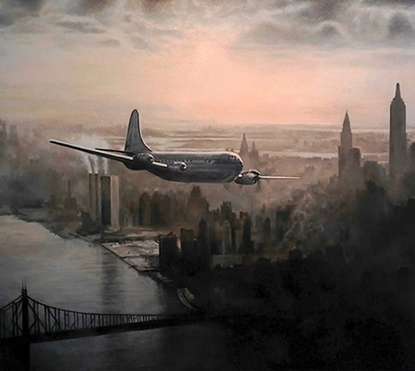
Lawrence Gipe, "Boeing 1949," 2017, oil on canvas, 60 x 68"
|
|
|
Lawrence Gipe
Lora Schlesinger Gallery, Santa Monica, California
by Suvan Geer
|
|
|
Continuing through July 14, 2018
|
|
|
For the Greek Sophists there was no absolute truth, there were always two sides to every issue and wisdom came from being able to recognize the truth in both of them. We however live in a world of ever shifting "alternate facts" about history and events where people argue from strictly one side or the other and call it wisdom. Within that increasingly tilted arena of emotionalized opinion that blinds one eye in order to not see the other side of anything Laurence Gipe's paintings have an even deeper resonance.
His big brooding chiaroscuro paintings… READ MORE
|
|
 |
|
|
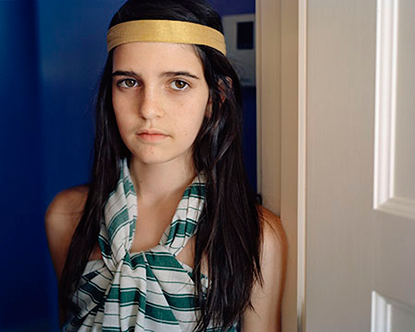
Betsy Schneider, "Jasper," Phoenix, AZ, 2012, photograph.
Image courtesy of Tilt Gallery, Scottsdale, AZ
|
|
|
Betsy Schneider
Doris and John Norton Gallery for the Center for Creative Photography at Phoenix Art Museum, Phoenix, Arizona
by Lynn Trimble
|
|
|
Continuing through October 14, 2018
|
|
|
Teens are at the forefront of American political life this year, calling for policy changes in the aftermath of school shootings and embracing the opportunity to vote once they reach 18. Today's 13 year olds will be 40 when the country shifts to having a minority majority. So, it's essential to explore the ways these youths are experiencing and thinking about themselves, their communities, and the world. That's just what Betsy Schneider accomplished in photographing 250 teens from around the nation in 2012, and asking each to share a personal… READ MORE
|
|
 |
|
|
Catherine J. Davis
Filter Photo, Chicago, Illinois
by Robin Dluzen
|
|
|
Continuing through July 21, 2018
|
|
|
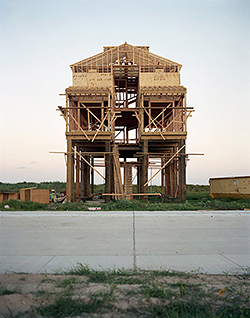
In "The Third Coast," Dallas-based Catherine J. Davis documents the realities of the U.S. Gulf Coast between Florida and Texas. Her landscapes tell a unique story about the relationships between water and land, and between humans and nature unique to this region. Ironically, this is skillfully done though photographs that are notably devoid of people, save for a handful appearing as details within dormant environments. Davis' pieces are glimpses of the everyday, chronicling… READ MORE |
|
|
Left: Catherine J. Davis, "SOLD, Galveston, TX," 2016, archival inkjet print,
40 x 32"
|
|
 |
|
|
Jun Kaneko
Traver Gallery, Seattle, Washington
by Matthew Kangas
|
|
|
Continuing through June 30, 2018
|
|
|
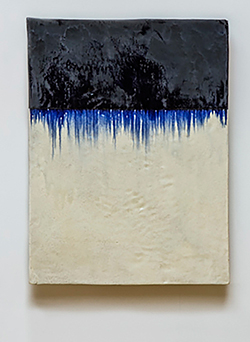
Omaha-based Jun Kaneko, second-wave pioneer of the contemporary clay movement in Los Angeles during the 1960s, is the subject of this carefully selected survey. Born in Nagoya, Japan, the 76-year-old grew up during World War II and arrived in L.A. at age 21, where he was shepherded by a wealthy collector couple, Mr. and Mrs. Fred Marer, and mentored by the Chouinard circle surrounding Peter Voulkos, Paul Soldner and others. Miraculously, his work never resembled theirs.
The remarkable results of this foreign exchange student's success in America are directly related to how he not only mastered ceramics as practice… READ MORE
|
|
|
Left: Jun Kaneko, "Untitled (Wall Slab)", glazed ceramics, 30 x 22 1/2 x 75"
|
|
 |
|
|
Reena Spaulings
Matthew Marks Gallery, West Hollywood, California
by Jody Zellen
|
|
|
Continuing through June 30, 2018
|
|
|
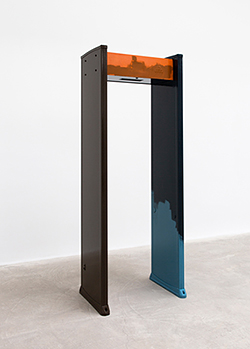
In "The Male Gates" Reena Spaulings, a collective as well as an art gallery founded in New York in 2004, the focal point is a suite of painted security gates arranged like the monuments of Stonehenge. Security gates have become a necessity not only in airports but more recently in schools and government buildings. Reena Spaulings transforms these all too familiar forms into painted sculptures that are both welcoming and foreboding.
The collective's is interested in how new technologies and everyday materials can be used and transformed into… READ MORE
|
|
|
Left: Reena Spaulings, "Gate 1," 2018, enamel paint on security gate,
87 x 32 x 23"
|
|
 |
|
|
| Visual Art Source (VAS) is the comprehensive online resource of critical discourse and information exclusively devoted to the contemporary and fine art world of the Western and Midwestern United States. ABOUT US.
|
|
|
Fabrik Magazine is an indispensable publication for art world professionals, collectors and those curious to encounter new ideas on contemporary art and design. Visit www.thisisfabrik.com for art world coverage that matters. |
|
|
| | |