|

|
 |
 |
|
|
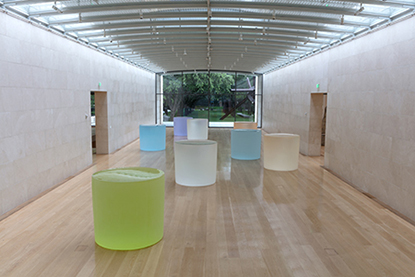
Roni Horn, installation view of Untitled sculptures, 2013–15, solid cast glass with as-cast surfaces, 50 3/4 x 56" diameter each. Courtesy of the artist and Hauser & Wirth. Photo by Kevin Todora
|
|
 |
|
|
|
|
|
Roni Horn
The Nasher Sculpture Center, Dallas, Texas
by John Zotos
|
|
|
Continuing through August 20, 2017
|
|
|
Seven large-scale sculptures by American artist Roni Horn (b. 1955) are each in a distinct color that glows with luminous intensity. This is Horn's first museum exhibition in the U.S. since 2010, and the first time these particular glass sculptures, the largest yet, have been seen in public. Additionally, this is the first museum showcase to focus solely on her cast glass sculpture. Their delicate surfaces deceptively belie an immense weight, each one at about five tons, the end result of a time-consuming fabrication process. It takes up to ten months to realize each one; they are made in a German glass foundry, where special… READ MORE |
|
|
Editors' Roundtable
by DeWitt Cheng
From time to time, articles appear, proclaiming the death of painting, or the death of art; both are always, to use Mark Twain's word, premature, and easily dismissed. However, the strange state of American culture in the Trump era, with its worship of money and its mingled fear of and contempt for creative expression calls for occasional reflection. We have been living and working for the past four decades or so in the so-called postmodernist era. Its characteristics as summed up by Wikipedia:
"Salient features of postmodernism are normally thought to include the ironic play with styles, citations and narrative levels, a metaphysical skepticism or nihilism towards a "grand narrative" of Western culture, a preference for the virtual at the expense of the real … and a "waning of affect" on the part of the subject …"
George W. Bush's administration touted 'faith-based reality' over 'fact-based reality,' so W was seen by some as the first postmodern president. It has been argued that today's "alternative facts" and fake news are not new, but legacies simply taken to a new level.
Nowadays, we read increasingly, however, that PoMo itself is no more. Tufts University philosopher Daniel Dennett, a critic of postmodernism, makes an argument that may sound familiar: "Postmodernism, the school of 'thought' that proclaimed 'There are no truths, only interpretations' has largely played itself out in absurdity, but it has left behind a generation of academics in the humanities disabled by their distrust of the very idea of truth and their disrespect for evidence, settling for 'conversations' in which nobody is wrong and nothing can be confirmed, only asserted with whatever style you can muster."
In the post-postmodernist age, we are invited to forsake the intellectual skepticism we imbibed in school (some of us) , the old-time irreligion, and to find new faith in … something. Culture critic Eric Lawrence Gans posits a "post-millennialist" rejection of politically correct "victimary thinking" in favor of "non-victimary dialogue" that will "diminish … the amount of resentment in the world." Alan Kirby, a British critic and author of "The Death of Postmodernism and Beyond" (2006), is less sanguine, assessing our current condition as "digimodernism" or "pseudo-modernism;" he enumerates our faults: "In pseudo-modernism one phones, clicks, presses, surfs, chooses, moves, downloads," excoriating even — is nothing sacred? — "the drivel found … on some Wikipedia pages."
This confusion about the intersection of philosophy and aesthetics came to mind as I absorbed Urs Fischer's show, "The Pubic and the Private" (through July 2) at the Legion of Honor. Fischer is a skilled artist in the conceptual mode, i.e., intellectual and provocative, but not emotionally engaging. The museum is displaying two bodies of his work: sixteen large bronze sculptures made from amateur artist clay models that are dispersed in the entrance courtyard, surrounding Rodin's "Thinker." And mixed-media paintings and sculptures that are installed at various points within the Legion's traditional galleries, surrounded by Renaissance, Baroque, Rococo and Neoclassical masterworks. The juxtaposition of old and new is so striking that I felt compelled to go back twice. The mashup effect reflects our current confusion about art's meaning and how it is affected by context. The exhibition, which celebrates the centenary of Rodin's death, is a mixed bag.
The Legion of Honor, you may recall, is a slightly reduced-scale replica, erected in 1924 on a hill overlooking scenic San Francisco Bay, of Pierre Rousseau's 1782 neoclassical Palais de la Légion d'Honneur in Paris. If the original Legion celebrates military valor and other meritorious service on behalf of the French nation, the San Francisco museum seems the very model of a traditional museum. Its Greco-Roman architectural style (so often copied for banks and treasuries) connotes stability, substance and endurance. A 1923 plaque mounted on the archway leading into the colonnaded courtyard commemorates "comradeship with the dead" of America's Great War, and Rodin's "Thinker" seemingly broods over Patrie et Honneur (Country and Honor), which is engraved on the entrance pediment.
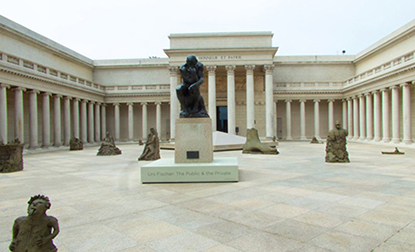
The juxtaposition between the lumpy antiheroic works and the classical columns enclosing the space like disciplined soldiers is odd in a good way. Only steps away from George Segal's Holocaust memorial, and encircling Rodin's masterpiece, these bronze turds are inept, funny and endearing. Louis XIV in a sagging ornate throne; the head of Napoleon, sporting the familiar tricornered hat and perched atop a column of slumping mud; a boy in a chair as an enervated, splayed protagonist; a man on a pile of dirt is a comic version of the Greek hero Prometheus, awaiting his daily evisceration by eagle; a Pietà boasting a monstrous Madonna instead of the eternally young Queen of Heaven.
Less fortuitous are the works installed within the museum galleries. Here, the juxtapositions become jarring to anyone with affection for Old Master art or historic artifacts. Fischer's oddball sculptures, mixtures of hardware-store fixtures and digital technology, are eccentric, but lack the dopey, excremental appeal of the works outside. "Invisible Mother," a partial skeleton lying in a chair and irrigated by water run though a hose, complete with gold coins in the fountain, feels like a prop from the "Pirates of the Caribbean" ride. "Fiction" is a table with a few objects, vibrating to symbolize "a mental state of blurriness." But there's nothing tentative about the dramatic Dutch portraits and landscapes behind it.
"Dazzled," a pair of large, disembodied eyes, is described as critiquing the artificiality of socially constructed ideals and objects. But they look away from a trio of English portraits and toward a pair of Scottish ones, unseeing and unblinking. "Kratz" is composed of a single bed filled with a disastrous amount gravel or cement that brings it close to collapse. Like competing optical illusions, cannot be seen simultaneously; they suffer from poor chemistry
I recently ran across the Japanese word tokonoma, an alcove dedicated to a single work of art. Artworks should be displayed either in isolation, to encourage contemplation, or in visual conversation with sympathetic works.
[The Editor's Roundtable is a column of commentary by our own editors and guest columnists from around the region. Their opinions do not necessarily reflect that of Visual Art Source or its affiliates.]
|
|
|
 |
|
Urs Fischer, "The Public & The Private," 2017, installation view in the courtyard of the Legion of Honor, bronze sculptures surrounding Auguste Rodin's "Thinker."
See DeWitt Cheng's column, left
|
|
|
|
 |
|
|
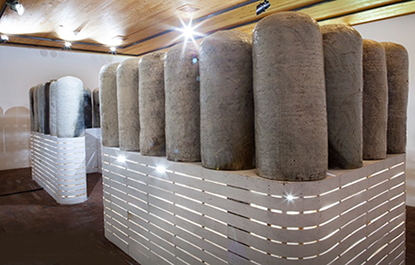
Daniel Johnston, "Pillar," 2017, wood-fired thrown stoneware
|
|
|
Daniel Johnston
Peters Projects, Santa Fe, New Mexico
by Kelly Skeen
|
|
|
Continuing through August 26, 2017
|
|
|
North Carolina potter Daniel Johnston transforms a spacious gallery space into a wooden labyrinth of narrowly constructed curved corridors. As we enter what feels like a weathered tobacco barn from the American South, we encounter fifty bulging vessels of precise shape and size stoically residing over claustrophobic passageways. The lidded jars' massive volumes are accentuated by their elevated placement, causing them to protrude out and envelop us in their watchful presence. As we venture deeper toward the epicenter of the structure our visibility becomes limited; the jars grow darker in value and the streams of reflected light become blocked by the narrowed proximity of… READ MORE |
|
 |
|
|
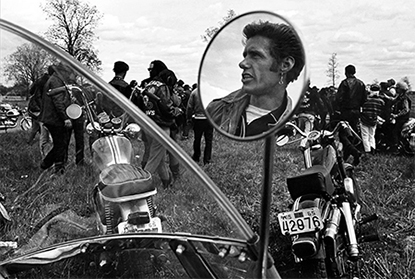
Danny Lyon, "Cal, Elkhorn, Wisconsin," 1965-66, vintage gelatin silver print. ©Danny Lyon/Magnum Photos, courtesy Etherton Gallery
|
|
|
Danny Lyon
Etherton Gallery, Tucson, Arizona
by Deborah Ross
|
|
|
Continuing through August 31, 2017
|
|
|
Danny Lyon shuns objective distance from the subjects of his narrative photographs. He immerses himself in the settings he's chosen to document. Coming on the heels of Lyon's 2016 retrospective at the Whitney Museum of American Art, this exhibition is a generous tribute to three important series from the 1960s and '70s, as well as selections from later projects. Most of the more than 60 photos are vintage gelatin silver prints, evoking a retro quality that transports us back in time yet has resonance today. They document historical events as well as the marginalized societies and slices of life that Lyon so stridently captured.
Included are several prints from Lyon's book… READ MORE |
|
 |
|
|
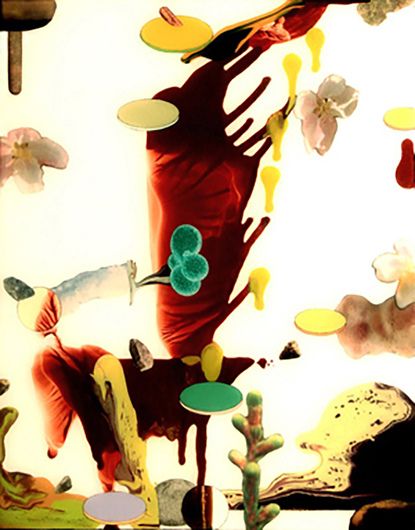
Mieko Hara, "Felix #4," 2017, acryic, oil, resin with collage on wood panel,
14 x 11"
|
|
|
“From the Studio”
R.B. Stevenson Gallery, La Jolla, California
by Roberta Carasso
|
|
|
Continuing through July 8, 2017
|
|
|
A group of four women painters adds up to a rich diversity of visual content. Mieko Hara is from Japan and a world traveler. She combines acrylic, oil, and collage on wood, with a coating of resin. Ten small, exquisite canvases are placed linearly on the wall, where their distinctions and similarities unfold as a group. Shapes are organic, as if we come upon a grove of dream-like plants and configurations never before seen. To these Hara adds dots of color, giving each painting a heightened sense of enigma.
Molly McCracken-Kumar covers each of her canvases with acrylic shapes, meticulously washed, approximately 40 times. Each washing leaves haunting shadows in the background that endow… READ MORE |
|
 |
|
|
Anna Fidler
Charles Hartman Fine Art, Portland, Oregon
by Richard Speer
|
|
|
Continuing through July 15, 2017
|
|
|
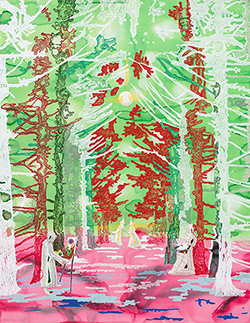
Anna Fidler has long been one of the Northwest's most original visual stylists. Her paintings — actually more akin to wall-based relief sculptures — layer strata of meticulously shaped colored papers into distinctive tableaux that are near-topographical in their three-dimensionality. In her new body of work, "Ettes and Esses" she deploys her formidable technique in a celebration of female empowerment. The show's title refers to suffixes that have been used historically to diminish… READ MORE |
|
|
Left: Anna Fidler, "the Five (Summer)," 2016, acrylic, gouache, colored pencilson paper, 52 x 40"
|
|
 |
|
|
Benjamin Weissman
The Box, Los Angeles, California
by Jody Zellen
|
|
|
Continuing through July 8, 2017
|
|
|
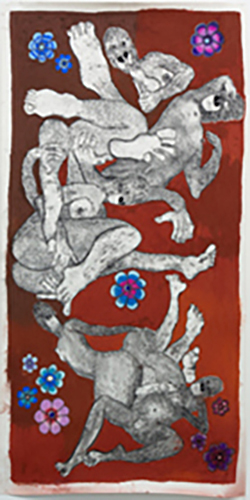
Benjamin Weissman is a fiction writer as well as a prolific visual artist whose current exhibition, "We Never Kissed," fills the gallery space with obsessive and disturbing works on paper that feature gorillas having sex. Weissman has a long history dealing with taboos and presenting that which has the ability to unnerve and shock — but in a matter-of-fact manner.
These colorful pastel and charcoal drawings depict cavorting figures that are simultaneously male and female, human and animal. The depictions are part-fantasy, part self-portraiture… READ MORE |
|
|
Left: Benjamin Weissman, "Nessa with Blue & Purple Flowers," 2016, pastel, charcoal on paper, 36 x 73"
|
|
| Visual Art Source (VAS) is the comprehensive online resource of critical discourse and information exclusively devoted to the contemporary and fine art world of the Western and Midwestern United States. ABOUT US. |
|
|
presented by:
|

|
|

|
|
| | |